
Workout
Rear Delt and Upper Back Workout
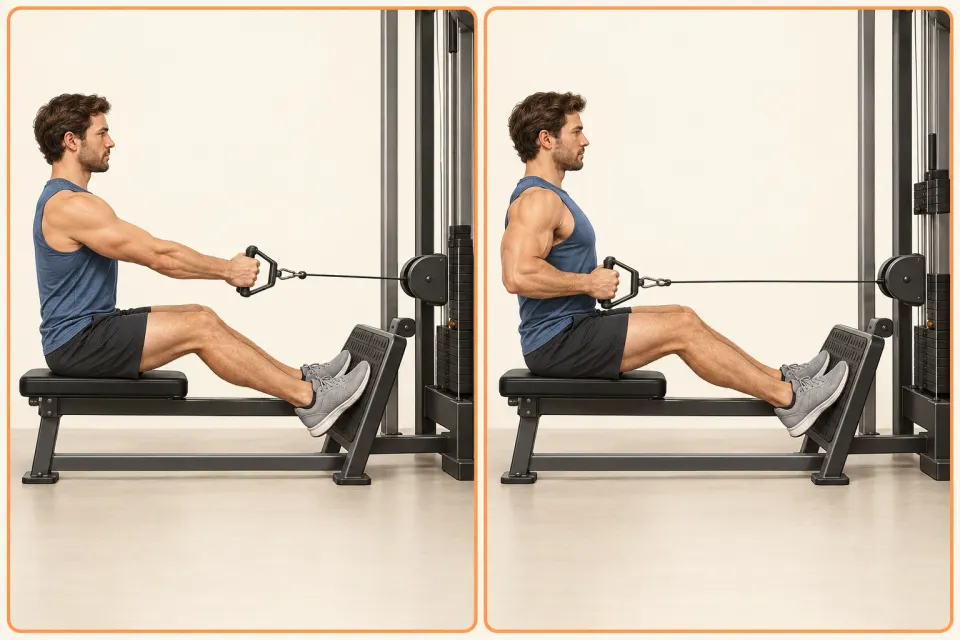
This upper back session uses 5 exercises and 17 working sets: T-Bar Row, Seated Cable Row, Reverse Pec Deck, Reverse Dumbbell Fly and Cable Rear Delt Row. Most sets stop 0 to 2 reps short of failure, with 1 to 2 minutes of rest between sets. Run it twice a week.
| Exercise | Sets | Reps | Reps in reserve | Rest |
|---|---|---|---|---|
T-Bar RowWide-ish grip, squeeze blades together | 4 | 8-10 | 1-2 | 2 min |
Seated Cable RowElbows wide, pause at contraction | 3 | 10-12 | 1-2 | 2 min |
Reverse Pec DeckPinkies lead, no trap takeover | 4 | 12-20 | 0-1 | 1 min |
Reverse Dumbbell FlyLight weight, three-count lowering | 3 | 12-15 | 0-1 | 1 min |
Cable Rear Delt RowPull rope to face, elbows high | 3 | 12-15 | 0-1 | 1 min |
 Seated Cable Row
| Muscle | Sets |
|---|---|
| Rear Delts | 13 |
| Upper Back | 10 |
| Lats | 7 |
| Biceps | 3 |
Why these exercises
Rear delts and the mid-back both work in horizontal pulling. Heavy rows come first, then lighter, higher-rep rear delt work suits both areas.
How to run it
Run it twice a week. Progress the rows with weight and the rear delt work with reps.
Reps in reserve is how many more clean reps you could have done when you stop a set: 2 means you stopped two reps short of failure, 0 means you could not do another. Heavy compound lifts sit further from failure than machines and isolation exercises, which are safer to push close.
The mistake to avoid
Shrugging on every rear delt rep. Keep your shoulders down so the rear delts, not the traps, do the work.
Fitting it into your week
A focused session is a tool for bringing one area up, not a whole program. Run it for one or two blocks of four to eight weeks, trim a little volume from other muscles to make room, and keep training everything else about twice a week. How to bring up a lagging muscle explains the approach.
Lifto's free plan generator builds the whole week around your days, session length and equipment. A new Lifto plan bases its starting sets on your recent training and experience, and it progresses through reps and weight from the sets you log. Lifto does not add sets on its own, so adding volume stays your decision.