 Lifto
Lifto
iPhone · Apple Watch · Android · Wear OS
Is your training enough? Lifto knows, muscle by muscle.
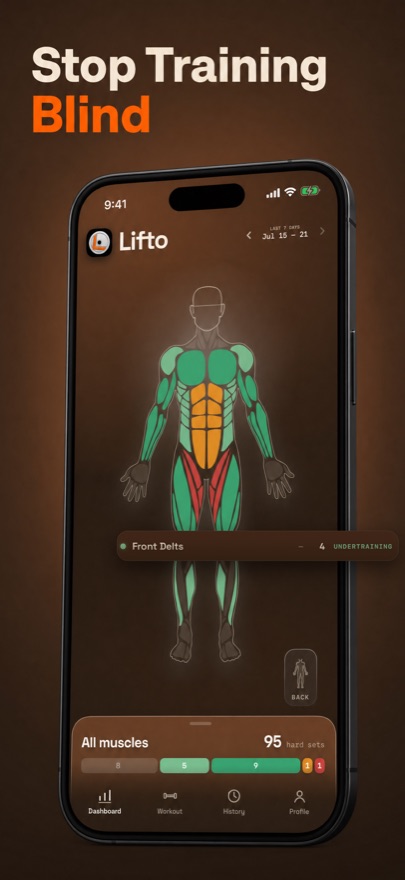
Lifto is a workout tracker for iPhone, Apple Watch, Android, and Wear OS that tracks weekly training volume per muscle group. It counts only your hard sets, credits every muscle a lift actually trains, and grades each muscle's week against study-backed ranges: enough to grow, falling behind, or overdone.
You author your own program. Lifto never prescribes one; it tells you whether yours is working and which lifts reach a lagging muscle.
- Category
- Workout tracker for evidence-based lifters
- Platforms
- iPhone and Apple Watch (iOS 18+), plus Android and Wear OS.
- Price
- $9.99/month or $59.99/year. 14-day free trial on both plans.
- Free tier
- Browsing your dashboard, history, and templates is free. Logging workouts requires Lifto Pro.
- Programs
- You author your program. Lifto carries it block to block and audits it; it never builds plans for you.
- Import
- No import from other trackers at launch.
- Sync
- Optional Lifto account sync and backup across supported devices. The app remains fully usable without an account.
- Evidence
- Every muscle credit is sourced to a published EMG study, with a tap-to-source receipt in the app.
- Support
- [email protected]
The mechanism
How the number works
Most trackers count every set equally and credit one muscle per lift. Lifto's weekly number passes two gates first, so it's one you can act on.
Only hard sets count
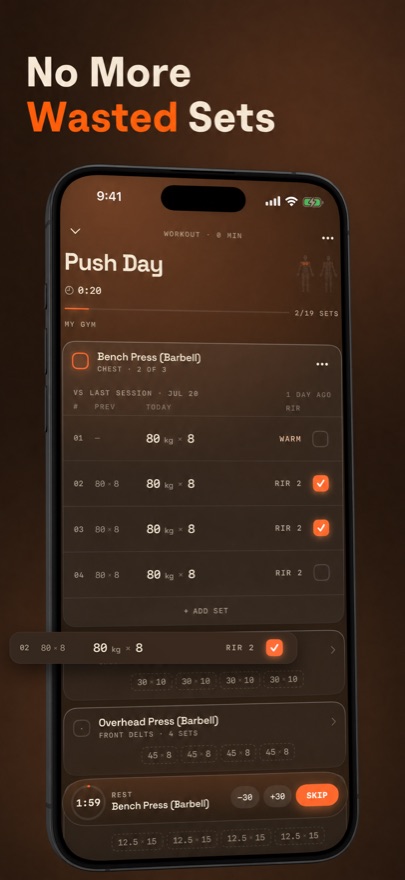
Warm-ups and easy sets score zero. A set counts toward a muscle only when it was taken close enough to failure to matter.
Every muscle gets its credit
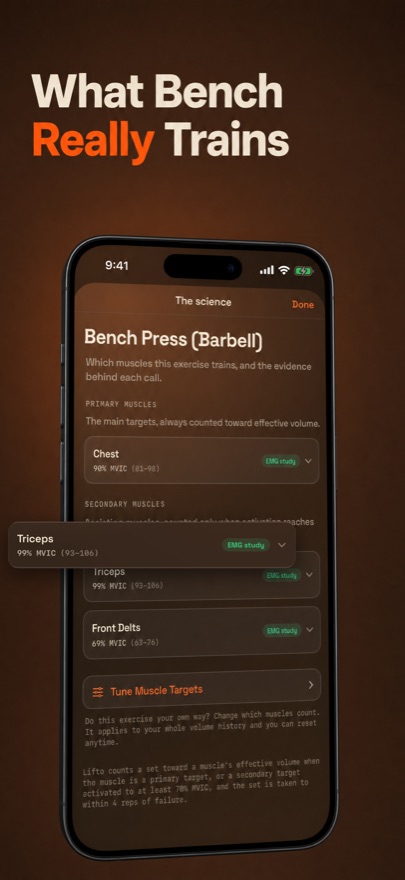
A lift credits every muscle it meaningfully trains, and each credit is sourced to a published EMG study. Chin-ups build biceps, not just lats.
Graded weekly, per muscle
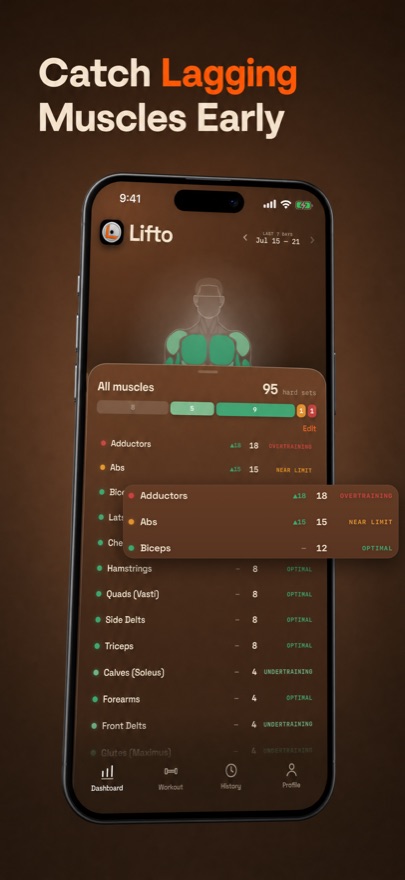
Weekly hard sets are plotted against the minimum that grows and the ceiling you can recover from, then graded so you know what to change.
| Muscle | Activation in cited study | Credited |
|---|---|---|
| Chest | 90% | CREDITED |
| Triceps | 99% | CREDITED |
| Front delts | 69% | NOT CREDITED |
Crediting is binary and strict: below the activation bar, a muscle gets nothing. No fractions, no vibes. Tap any credit in the app to read the study it comes from.
Features
What Lifto does
- Weekly effective volume per muscle group: hard sets only, every trained muscle credited, graded against study-backed weekly ranges.
- Lagging-muscle fixes: when a muscle falls behind, Lifto shows which lifts actually reach it.
- Progression tracking: weight, reps, and effort across sessions and training blocks.
- Your program, carried: author any split, run it block to block, periodization included. Templates like Push/Pull/Legs are scaffolds you edit and own.
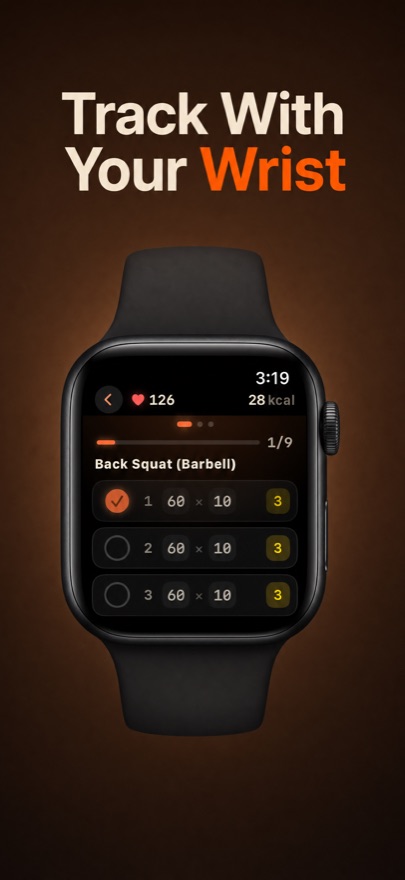
- Apple Watch app: log weight, reps, and effort from your wrist with the Digital Crown; entries autofill from last time.
- Rest timer as a Live Activity: on the lock screen and Dynamic Island, no app switching.
- Optional account sync and backup: switch supported devices and keep every workout.
- Wear OS companion: quick workout logging from a paired Android watch.
- Named-study receipts: every muscle credit links to the EMG research behind it.
On your wrist
Log the whole session without touching your phone
The Watch app is a full logging surface, not a remote. Turn the Digital Crown to set weight, reps, and effort; the next set autofills from your last. The rest timer runs as a Live Activity on your iPhone lock screen and Dynamic Island.
Side by side
Lifto vs Strong vs Hevy
Strong and Hevy are excellent, mature loggers with big communities and generous free logging. Lifto is newer and keeps its free mode focused on browsing. What Lifto does that they don't is audit the log it collects.
| Capability | Lifto | Strong | Hevy |
|---|---|---|---|
| Free tier | Yes · browse free; Pro to log | Yes, limited | Yes, generous |
| Counts secondary muscles a lift trains | Yes, EMG-sourced credits | Primary muscle only | Primary muscle only |
| Filters warm-ups and easy sets out of volume | Yes, hard-set gate | Counts every set | Counts every set |
| Weekly per-muscle grading vs study ranges | Yes | No | No |
| Years of polish and community features | New for 2026 | Yes | Yes |
If you want a free logger, pick Hevy and you'll be happy. If you want to know whether your training is enough, muscle by muscle, that's the job Lifto exists for.
Fit check
Who Lifto is not for
- You want an app to build your plan. Use Fitbod or Alpha Progression. Lifto audits the program you wrote; it won't write one.
- You want free workout logging. Use Hevy. Lifto lets you browse for free, but logging requires Pro after the 14-day trial.
- You want prescribed, done-for-you science programs. RP Hypertrophy sells exactly that. Lifto is for lifters who run their own.
- You train for endurance or general fitness. Lifto is built around muscle growth: sets, load, and per-muscle volume.
Pricing, plainly
One subscription, two plans
$9.99/month · $59.99/year
Both plans start with a 14-day free trial and unlock everything: unlimited logging, the per-muscle weekly verdict, programs, watch companions, and optional account sync. No feature tiers, no add-ons.
Free without Pro: browsing your dashboard, history, and templates. Logging workouts requires Pro. Subscriptions renew automatically and can be cancelled anytime in your App Store or Google Play subscription settings.
FAQ
Questions, answered straight
Is Lifto free?
Lifto is free to download, and browsing your dashboard, history, and templates is always free. Logging workouts requires Lifto Pro: $9.99/month or $59.99/year, each with a 14-day free trial.
Does Lifto work with Apple Watch?
Yes. Lifto ships a full Apple Watch app: log weight, reps, and effort with the Digital Crown, with autofill from your last session. The rest timer runs as a Live Activity on your iPhone.
Does Lifto have an Android app?
Yes. Lifto is available for Android and includes a Wear OS companion for quick workout logging.
Does Lifto import from Strong or Hevy?
No import at launch. Optional Lifto account sync keeps your workout history backed up across supported devices.
Does Lifto make workout plans?
No. You author your program and Lifto carries it block to block, then audits whether it's enough for each muscle. Built-in templates like Push/Pull/Legs are starting scaffolds you edit and own, not generated plans.
What is effective volume?
Effective volume is the number of hard sets a muscle actually receives in a week. Only sets taken close to failure count, and every muscle a lift meaningfully trains gets credit, sourced to named EMG studies.
Which studies back the muscle credits?
Each exercise's credits cite published EMG research by name, for example Youdas 2010 on chin-ups and Contreras 2015. In the app, every credit has a tap-to-source receipt showing the study behind it.