
Workout
Back Width Workout: Lats
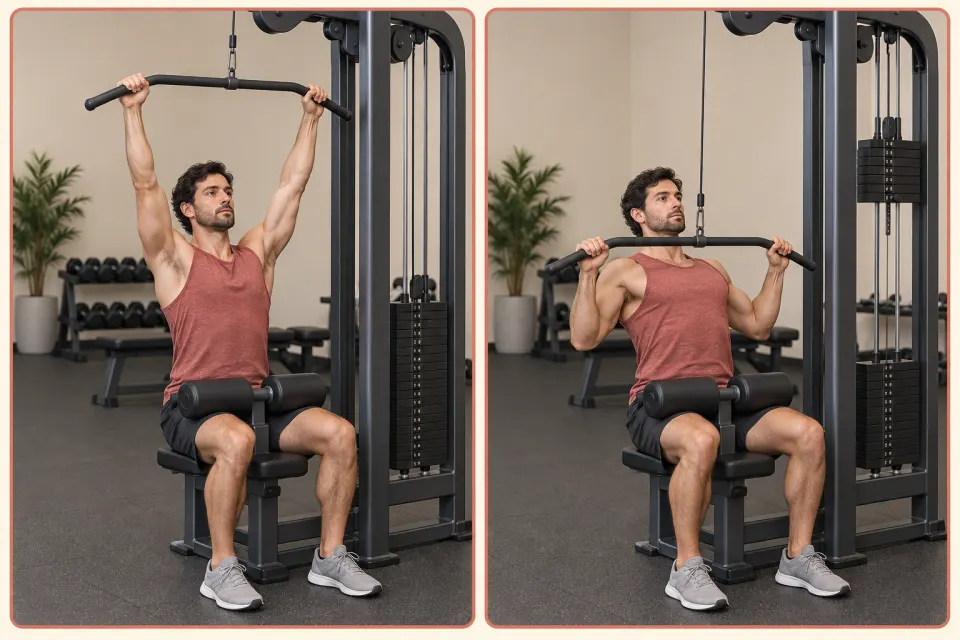
This back width session uses 4 exercises and 12 working sets: Lat Pulldown, Pull-Up, Machine Pullover and Underhand Pulldown. Most sets stop 0 to 2 reps short of failure, with 1 to 3 minutes of rest between sets. Run it twice a week, paired with the back thickness workout or a row day.
| Exercise | Sets | Reps | Reps in reserve | Rest |
|---|---|---|---|---|
Lat PulldownElbows down and in, stretch tall | 4 | 8-12 | 1-2 | 2 min |
Pull-UpDead hang each rep, no kipping | 3 | 6-10 | 1-2 | 2-3 min |
Machine PulloverLats pull, arms barely bend | 3 | 12-15 | 0-1 | 1 min |
Underhand PulldownSlow stretch overhead, squeeze low | 2 | 12-15 | 0-1 | 1 min |
 Lat Pulldown
| Muscle | Sets |
|---|---|
| Lats | 12 |
Why these exercises
Every exercise trains the lats' main job, pulling the arm down toward the body, and the pullover isolates the lats without the biceps.
How to run it
Run it twice a week, paired with the back thickness workout or a row day. Progress weekly and take an easier week when you stall.
Reps in reserve is how many more clean reps you could have done when you stop a set: 2 means you stopped two reps short of failure, 0 means you could not do another. Heavy compound lifts sit further from failure than machines and isolation exercises, which are safer to push close.
The mistake to avoid
Pulling with your arms. Start each rep by driving your elbow down toward your hip, and let the hands just hold on.
Fitting it into your week
A focused session is a tool for bringing one area up, not a whole program. Run it for one or two blocks of four to eight weeks, trim a little volume from other muscles to make room, and keep training everything else about twice a week. How to bring up a lagging muscle explains the approach.
Lifto's free plan generator builds the whole week around your days, session length and equipment. A new Lifto plan bases its starting sets on your recent training and experience, and it progresses through reps and weight from the sets you log. Lifto does not add sets on its own, so adding volume stays your decision.